Competitive intelligence rarely fails at collection. It fails because nobody defined what a finding is, so the reading never lands on a decision. Which of last quarter's screenshots changed something you did?
Your workspace holds a folder of screenshots, a pricing PDF from March and three Slack channels of links. Which of those changed a decision this quarter? If none did, coverage is not your problem. Nothing in that pile reads as a finding. I have watched the same scene in three agencies. Someone opens the shared drive, scrolls past a competitor's pricing page, a screenshot of a new onboarding flow, a funding announcement, then closes it, because none of it says what to do on Monday. That competitor moved its entry tier downmarket two months ago, and the first person to notice was a prospect.
The Definition and the Types Are Already Answered
The taxonomy is settled. Competitive intelligence gets sliced into strands, market, competitor, customer, product, and the page you landed on almost certainly lists them. The definition is settled too: the legal and ethical collection and analysis of information about a competitor's capabilities, vulnerabilities and intentions.
None of it tells you what to do on Tuesday.
What the field does supply is the shape of the work: collect, analyze, distribute, act, review. Several pages ranking for this term now run that cycle with an owner on every step and a cadence attached. Read them and you will know that a brief should end with a recommendation and a named owner.
Then most of them stop, right before the smallest unit in the system. If you cannot say what a finding is, you have four steps you can rename and one step nobody can staff. The upstream work, comparing two or three competitors on purpose rather than continuously, is a different job, and our competitor analysis framework covers it.
What Counts as a Finding
A finding is a sentence with a decision attached. That is the whole definition, and it is stricter than it sounds, because most of what lands in the folder is a fact with nothing on the other end of it.
The sentence shape: observed, changed, therefore
The shape is deliberately boring. Observed names the thing you saw, where you saw it and when. Changed says what moved against your baseline. Therefore states the consequence for a decision you already own.
Here is a worked example, invented for the shape rather than pulled from a client file: "On September 12 the competitor cut its entry tier from five seats to three and held the price, so our five-seat starter now wins on seats in every deal under twenty users, which means sales should lead with seat count instead of discount in the SMB segment."
Three parts, one sentence, ending in a change of behavior. You can disagree with the inference, which is the point. A finding nobody can argue with is usually a press release.

Why "competitor launched a feature" is not a finding
Run three tests.
Name the decision it changes. If you cannot finish "because of this, we will...", you have news, not intelligence.
Swap the competitor's name. Put any other company in your market in that sentence. If it still reads true, it was never about them.
Check the age. If the observation predates your last decision on that part of the product, you are filing history.
The failure the data describes is one of discrimination, not coverage. In Klue's AI in Competitive Intelligence Report 2026, a vendor-published survey of more than 250 CI and product marketing professionals, 36% said their AI tools could not tell a real competitive threat from a passing mention. More sources will not fix that.
Collection You Can Sustain
Two people cannot read the internet. They can read four things on a schedule, which is why the useful question is not what to collect but what to stop reading.
The four sources worth a weekly look, and the ones to stop reading
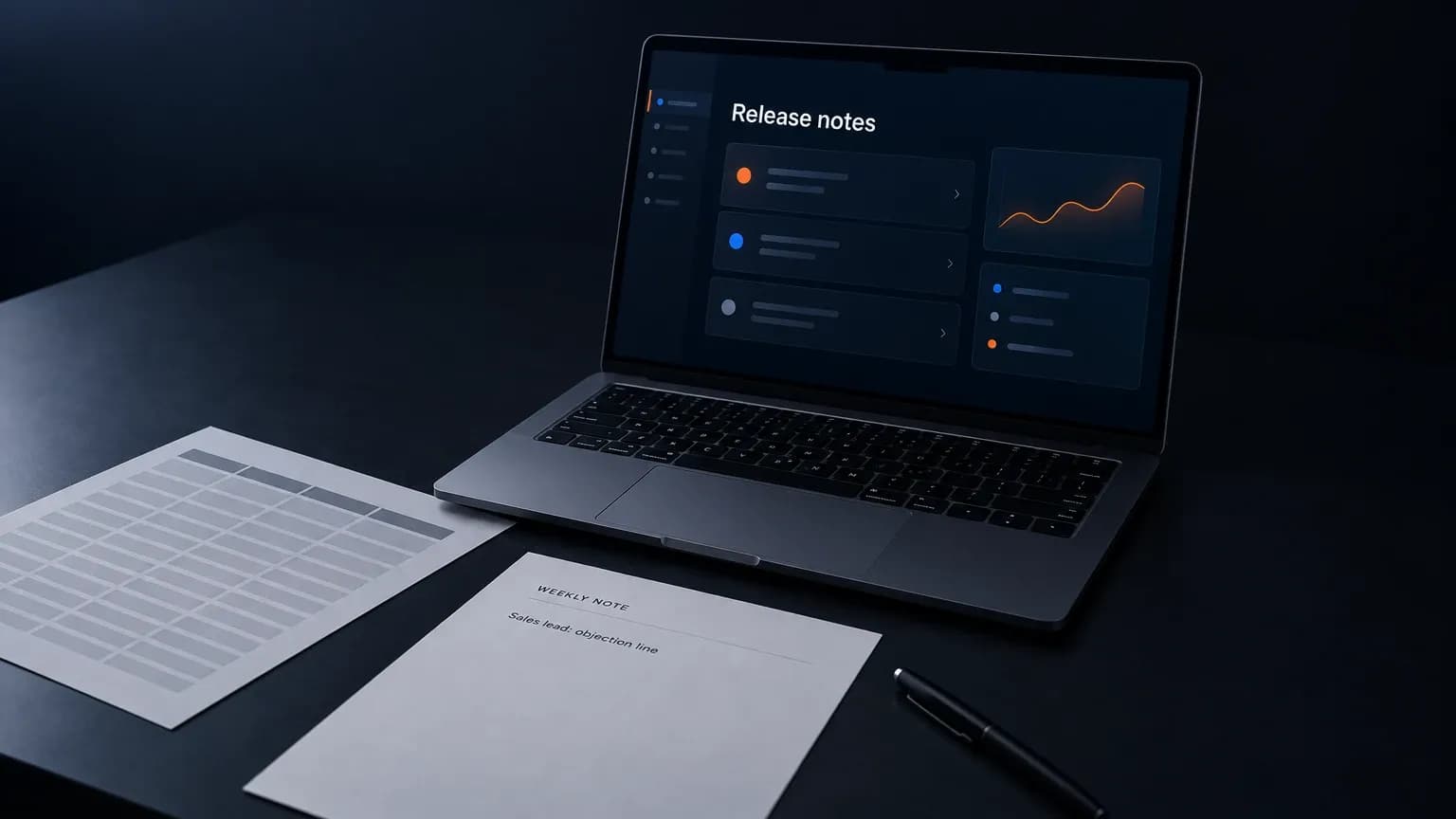
Watch the pricing and packaging page, the release notes, the job postings in one function and your own win-loss notes.
That fourth one is the source teams skip. Crayon's 2026 State of Competitive Intelligence, a vendor-published survey of CI and revenue leaders, puts internal sources such as employees, documents and call recordings at 54%, ahead of competitor websites at 48%. Your call recordings are the only source that shows what happened inside a deal, and they are already recorded.
Now the subtractive half. Stop reading competitor-news newsletters that summarize other people's summaries. Stop reading funding announcements unless the money changes hiring or pricing. Stop reading social mention streams, which measure noise rather than consequence. Stop reading review-site averages, which lag reality by two or three quarters.
If you want tooling for the collection layer, treat that as its own decision. We covered the trade-offs in competitor monitoring tools without pretending a feed solves a judgment problem.
Source hygiene: dates, locale, and the pages that quietly change
Two things go wrong with every capture, and both are cheap to prevent.
The first is the date. In the same Klue survey, 81% of respondents said they could not tell how fresh their own competitive data was. A screenshot with no date is a rumor with a border. Put the capture date in the filename and in the first cell of whatever row you keep.
The second is locale. A pricing page served to a US visitor is not the one served to a German buyer, and that difference is usually the thing you are trying to compare. Save the URL with its locale, and note currency and tax treatment.
Then watch the pages that change without announcing anything: pricing, packaging, terms of service, the careers page. None of them publish a press release. All of them tell you what a company is about to do.
The Analysis Step
Analysis is not a document. It is one question applied to every candidate finding, followed by a sort.
Sorting signal from noise with one question
Ask: what decision would change if this turned out to be true?
If you can name the decision, you have a candidate. If you cannot, you have a note. The question is brutal on purpose, because it fails most of what arrives. It also fails usefully: when something survives, the decision it names is already the routing instruction.
The baseline you compare against comes from your own properties, not from a competitor's page. If that baseline is a dashboard nobody trusts, fix it first, and the tooling question is a separate read in marketing analytics tools.
The two-axis read: how much it changes, how fast we must answer
Sort what survives on two axes, and resist adding a third.
How much does it change? A pricing model shift that touches every deal is high. A new integration page is low. Be honest here, because teams routinely inflate magnitude to justify the reading they already did.
How fast must we answer? A competitor undercutting your entry tier in an active pipeline is fast. A patent filing is slow, however interesting.
High magnitude and fast gets handled this week, by a person, with a deadline. High magnitude and slow becomes a quarterly readout item, which is where strategy work belongs. Low magnitude and fast is usually a sales objection, not an intelligence program, and it goes to the sales lead as a line, not a slide. Low magnitude and slow goes in the log and nobody reads it again.
Valona's Global Market and Competitive Intelligence Report 2026, drawn from 196 respondents across 143 companies, found 63% of intelligence teams stuck between reactive and strategic, with the top 7% running operations that shape strategy. The two-axis sort is one way out of the middle.
Routing It to a Decision
A finding that reaches nobody is a hobby. Routing turns analysis into a habit, and it fails because everyone assumes someone else owns the inbox.
Who receives which finding, and the one that must go to sales first
What you found | Who reads it first | When | What they do with it |
|---|---|---|---|
A pricing or packaging move | Sales lead | Same week | Rework the objection line for the affected segment |
A release that closes the gap your pitch leans on | Product lead, then content | Next weekly note | Rewrite the differentiator before the next launch |
A shift in their positioning or proof | Marketing lead | Next weekly note | Check whether the comparison page still reads true |
A hiring pattern in one function | Sales leader | Monthly readout | Adjust forecast assumptions for that segment |
Anything that changes no decision | Nobody | Never | Delete it, or log it and stop reporting it |
The first row matters most. A finding a rep can lose a deal to this month goes to sales before it goes into any deck, because a week of delay there converts into lost revenue. Which segment to watch first is itself a segmentation, targeting and positioning question, worth answering once instead of every quarter.
The other thing that decides whether this survives is the sponsor. Crayon's survey found only 56.7% of teams have an executive sponsor in sales, and that teams with one report revenue impact at 77% against 44% without. The report calls the sponsor the practice with the biggest return and the smallest uptake, which matches what I see: the program rarely dies from lack of data. It dies because no senior person notices when the weekly note stops arriving.
A two-person team does not need a VP. It needs one named person in sales who reads the note and replies, even if the reply is one line.

The cadence: weekly note, quarterly readout
The weekly note is five bullets at most, one sentence per finding, on the same day each week, with the decision and the owner named in the sentence. It takes forty minutes once the rest is in place. Teams that share findings weekly or faster report revenue impact at 79%, against 41% on a monthly-or-slower rhythm, according to Crayon's 2026 survey. Frequency does the work, not format, which is bad news for anyone hoping a nicer deck will fix a quarterly habit.
The quarterly readout is different: three to five patterns that only make sense in aggregate, a short list of what you decided not to respond to, and one change to the plan. Keep it under four pages. Anything longer gets skimmed and then cited as approval for decisions nobody made.
When a CI Platform Earns Its Price
There is a threshold, and it is arithmetic rather than ambition.
Count the sources you read every week, with a name and a date attached. Count the hours capture and formatting consume, multiply by a loaded hourly rate, add the findings you missed last quarter, and compare that total with a license at your seat count. If the number is small, buying a platform only moves the same bottleneck behind an interface.
The trigger is volume, not aspiration. You have earned the platform when the sources you must watch exceed what two people can hold on a Tuesday, when the same observation is captured twice in different formats, or when an audit needs a citation for a finding from fourteen months ago and nobody can produce it.
Until then, the honest answer is a spreadsheet, four sources and one weekly note. We worked through the full cost argument, including what a platform adds once you cross that line, in competitive intelligence tools. If you are still choosing what to watch rather than deciding whether to buy, start with market research tools instead.
The version we run at Allable keeps the competitor captures, the finding log and the weekly note in one project, because a note dies whenever it lives in a document nobody opens twice.
Conclusion
The definition is free and the taxonomy is everywhere, so neither will differentiate your work. What you can build in an afternoon is the part the field skips: a sentence shape that forces a decision, a capture habit with dates on it, a two-axis sort, and a routing table with one name per row.
Start with the folder you already have. Pick five items, write each as observed, changed, therefore, and count how many survive. My guess is one, maybe two. What would have to change in your week to keep that number climbing?
Frequently Asked Questions
What is competitive intelligence analysis?
The step between collecting signals and making a decision. It is the work of turning an observation into a sentence that says what changed against your baseline and what you will do about it, then sorting those sentences by how much they alter and how fast you must answer. Collection is easier, and it is not where programs fail.
How is it different from competitor analysis?
Competitor analysis is a project with a start and an end, run to answer a positioning, launch or pricing question. Competitive intelligence is a standing operation that repeats on a cadence and produces findings instead of a deck. The project version is the right starting point if you have never done one, and a competitor analysis framework makes it repeatable.
How do you do competitive intelligence with a small team?
One owner, four sources, one weekly note, one named reader in sales. Assign the owner by name rather than by role, cap the note at five findings, and refuse any finding that cannot name the decision it changes. Add a source only when the existing four keep producing findings.

Run the cycle in one place
Keep the captures, the finding log and the weekly note in one project, so the note never lives in a document nobody opens twice.