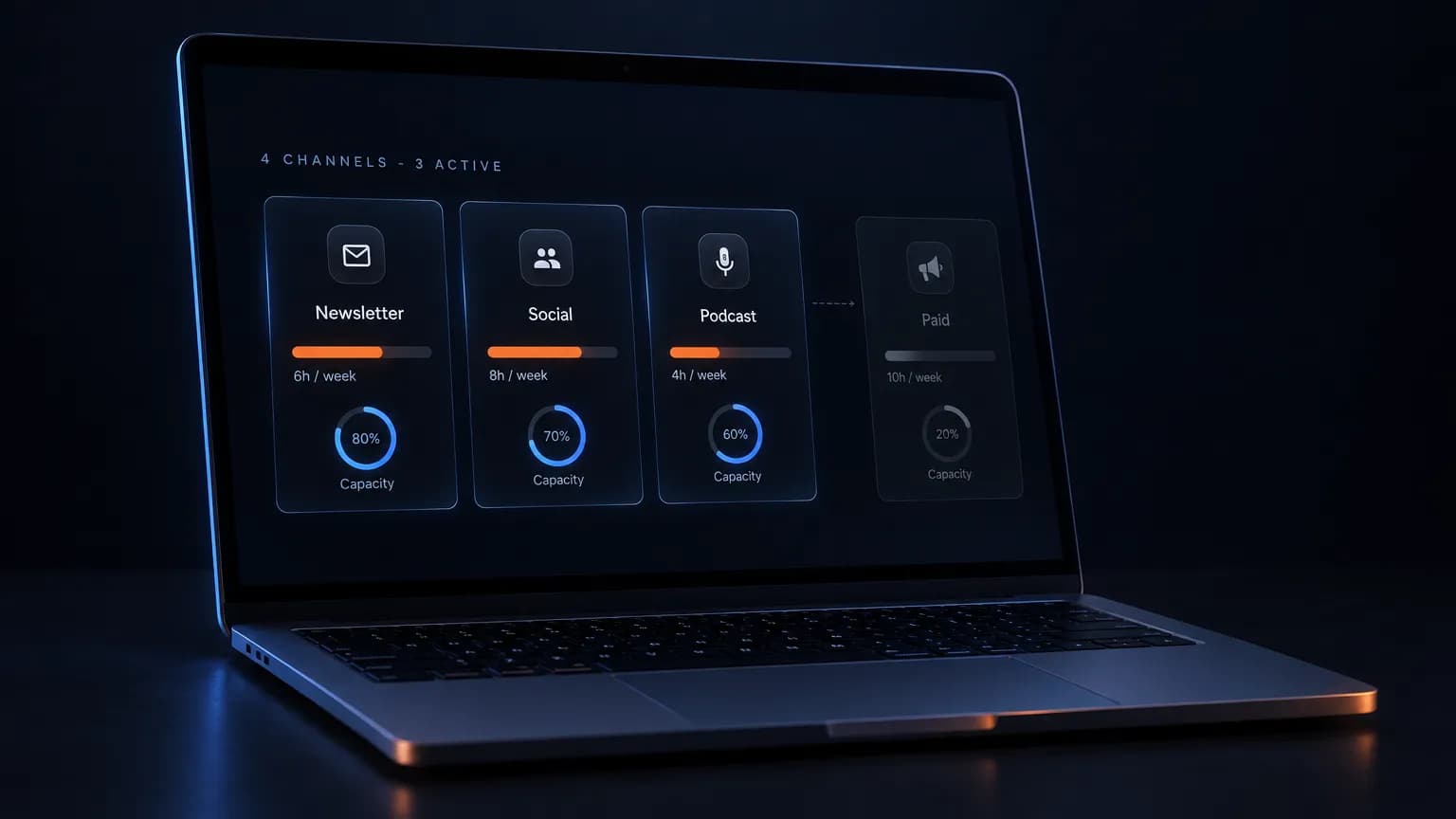
Adding a channel takes an afternoon. Keeping it takes hours every week. So which two would you keep if the rest had to go tomorrow? The hours decide, and nobody has ever counted them.
Twelve posts, four channels, a spreadsheet with a color per platform. That was the content distribution strategy I built for one of our own clients, and it lasted nineteen days. By week three two of the four channels were empty and nobody had said out loud that they were abandoned.
You have a version of that running now, probably in a tab you have stopped opening. There is a channel on it that has not produced a finished piece since spring, and no meeting ever decided to stop it. It still takes a slot in someone's week while the two channels that actually work get whatever is left, and the quarterly review asks why reach is flat.
Each channel on that list arrived on a day it looked cheap: a newsletter because email feels owned, a video channel because a competitor's video worked, a podcast because the format finally got easy to produce. None of those calls were wrong at the time. The cost landed later, in two people rewriting the same piece four times a week, and it landed without an invoice.
Content Distribution Strategy Is a Capacity Decision
The first number you need is how many hours one piece costs before anyone distributes it. Channel count comes later.
Orbit Media's 12th Annual Blogger Survey, which surveyed 808 bloggers and captured data in August 2025, puts average time on a typical article at just under three and a half hours. That is writing. It does not include the edit, the image, the scheduling, the replies, or the version cut for another platform. Orbit is also honest that its sample leans on the author's own network, so treat the figure as the best public number available rather than a law.
Then cost your own list. These are my working numbers, not measured ones: a weekly newsletter takes two to three hours fresh, a single social surface two to four across the week, and a podcast most of a day once recording, editing and show notes are counted. Four channels is a second part-time job nobody applied for.
The population this is written for makes it sharper. The SBA's Office of Advocacy counted 36.2 million small businesses in the United States in its February 2026 fact sheet, which is 99.9 percent of all businesses and 45.9 percent of private-sector workers. At that size, the person choosing channels is often the same person writing the post, answering the comments and sending the invoice.
CMI's 2026 B2B trends report, run with MarketingProfs on a survey of 1,015 B2B marketers, makes the point from the other direction. It ranked channel selection and optimization seventh among what moved the needle for effective teams, at 36 percent, behind content relevance and quality at 65 percent and team skills at 53 percent. The same report puts investment in salaries, training and development last among 2026 priorities at 9 percent, while AI tools lead at 45 percent.
Put the 45 percent and the 9 percent side by side. Teams are buying tools that let them run more channels, and funding the people who would run them last. That is how a five-channel list gets built on a two-channel team.
If the real problem is that no plan sits behind the channel list, the content strategy template is where that work starts. This article assumes the plan exists and asks a narrower question: which of these channels do you stop?
The Drop Decision That Makes the Strategy Real
The published advice on this subject is additive by default. Every ranking guide teaches you how to add a channel, and the AI summary at the top of the results does the same. None supplies a test for removing one, with the capacity arithmetic behind it. Our own strategy template has a stop-doing list, but it covers topics and cadence, not channels.
Here is the version that fits in a spreadsheet.
Which channel to abandon first, and the test that says so
Write down the metrics you already put in a report, the ones a budget holder actually reads. That is usually fewer than the ones you track.
Then, for each channel, ask what would visibly change in that report if the channel stopped tomorrow. Not in a year. Next month, in the document you already send.
Score each one on three questions: does it appear in one of those reported numbers, does that number move within a month, and would anyone outside your team ask where it went. One or none means it is a candidate.
Stop the lowest-scoring channel for one quarter. Your least visible channel, not your worst performer. That is the cheapest decision to defend, because nobody has to explain a number that did not move, and the easiest to reverse, because nothing you were relying on has gone.
Before you stop it, write the re-entry condition. We restart this if a specific signal appears by a specific date. Without that line the decision degrades into an argument in month five, and the channel comes back because someone senior missed seeing it.
Put the arithmetic on one line and the decision usually makes itself. At three and a half hours to write, plus two hours to place one piece properly across two channels, a single article already costs most of a working day. Add a third channel and that is a full day per piece. Publish twice a week and the week is gone before anyone answers an email. That is a number a budget holder can follow, which is why it wins the argument that a channel count never does.

One more warning. Do not run this test on paid search first. Paid is the only row in your list where stopping the money stops the result immediately, which makes it look like the weakest channel and feel like the easiest cut. It is usually the one keeping the pipeline alive while the owned channels compound.
What to keep when you can only keep two
Choose the pair that shares a production unit. One piece of work feeds both without a second production run.
Long-form to email plus one social surface is the pair I keep coming back to. The article is the source, the newsletter is its middle argument, and the social post is its sharpest paragraph. No second production run, no second set of facts to check. A newsletter plus a podcast looks efficient and is not, because each one starts from zero.
I would also insist that one of the two is a channel you own. An email list is the only distribution surface where a platform decision cannot take your audience away in a week. Everything else is rented, including the ones that feel permanent.
Then leave the pair alone for thirty days. Long enough to see whether the second channel is genuinely fed by the first, short enough that you remember why you chose it. If you find yourself producing separately for both, they are not sharing a unit and you have three channels again.
Owned, Earned, Paid: What Each Costs You
The pages ranking here run this taxonomy as a definitions lesson. You do not need the lesson. You need the cost column, because the cost is what decides whether the channel survives a busy month.

The hours below are mine, worked from the production unit above rather than measured on your team. Treat them as a starting estimate to correct, not a benchmark to hit.
Channel type | Weekly cost in hours | Payback shape |
|---|---|---|
Owned, such as a newsletter or a blog | Three to six for a weekly newsletter, four to eight for a podcast with editing | Slow at first, then compounding. The only type where a piece published last year still works this year |
Earned, such as pitches, communities, review replies, guest slots | Two to four, mostly relationship time | Lumpy. One placement can pay for a quarter, and three quiet months pay nothing |
Paid, such as search, social or sponsorships | One to three to operate, plus creative work at every refresh | Immediate, and it stops the day you stop paying. The only type with a real cost per outcome |
The payback shape is the part people misread. Owned looks expensive per hour and cheap per year. Paid looks cheap per hour and cheap only while it runs. Earned looks free and is the least predictable, which is why it is a bad choice for the channel you rely on this quarter.
If what you are choosing is where a product gets sold rather than where content gets published, that is a different decision, and we covered it in distribution in the marketing mix.
Repurposing Without a Content Factory
Start with one source asset, and make it long-form, because it holds the most raw material and it is the only format where you can say something for long enough to be worth cutting.
The rule is three cuts and no new production. A cut may be shorter, reformatted, or re-argued for a different reader. It may not need an interview, a new image set, or a second round of fact-checking. The moment it needs one of those, it is a new asset, and it belongs in next month's production budget.
This is what separates a content promotion strategy that works from one that quietly becomes a second content operation. A promotion strategy assumes the asset already exists and asks where it travels. A production strategy assumes every surface needs its own original work, and that is the version that runs out of people.
In a normal week that looks like this: one article, one newsletter section built from its middle argument, one social post built from its sharpest paragraph, and one answer dropped into a community where the question already exists. Four surfaces, one piece of work, no new writing.
The failure mode is the factory. A repurposing system that produces six cuts and needs a producer has not solved distribution. It has added a channel called derivatives and staffed it with the person who was supposed to be writing.
This is the shape I built Allable's social scheduling around, and the reason a post scheduler sits beside the article pipeline rather than in a separate tool. Two channels fed from one source asset is the case the product assumes. If you would rather buy the capacity than build it, that is content marketing services and a different budget conversation.
What Dark Social Does to Your Distribution Numbers
One thing keeps happening after you cut back to two channels: the referral report undersells the social surface you kept. Shares in private groups, direct messages and group chats land as direct traffic or as nothing at all, so the channel looks quieter than it is.
That matters for the decision above, not for your dashboard. If you drop a channel because it drives no traffic, you may be reading a measurement gap as a verdict. We explain why the measurement breaks, and what to watch in its place, in our piece on the dark funnel.
Conclusion
A content distribution strategy is a channel list you can staff. One you cannot staff is a calendar nobody opens. Cost your current channels in hours this week, drop the one whose absence nobody would notice, and write down what would make you add it back.
Do that once a quarter and the list stops growing on its own. The channels you keep should be the ones you chose.
FAQ
What is a content distribution strategy?
It is the decision about which channels you publish into, what each one costs you per week in hours, and which ones you have decided not to run. That last clause is the one the ranking guides leave out, and it is what makes the other two real. A list with no exclusions is a wish list.
Which channels should a small team use?
Two, and they should share a production unit. For a team under five people that means long-form writing plus email, with one social surface fed from the same pieces. You get an owned channel where the work compounds, plus one borrowed surface for reach. Add a third only when the first two run without anyone chasing them.
How many channels is too many?
There is no universal number, and anyone quoting one is guessing. The test is whether every channel on your list gets a genuinely finished piece in a normal week. If two of them get only what is left over, you are running more than you can sustain. For a team of one or two, the line usually falls at two.

Start with two channels and one source asset
Allable keeps the research, the article pipeline and the social scheduling in one project, so one source asset can feed both channels without a second production run.